# loglevel-plugin-prefix
Plugin for [loglevel](https://github.com/pimterry/loglevel) message prefixing.
[](https://www.npmjs.com/package/loglevel-plugin-prefix)[](https://travis-ci.org/kutuluk/loglevel-plugin-prefix)
## Installation
```sh
npm install loglevel-plugin-prefix
```
## API
**This plugin is under active development and should be considered as an unstable. No guarantees regarding API stability are made. Backward compatibility is guaranteed only by path releases.**
#### `reg(loglevel)`
This method registers plugin for loglevel. This method must be called at least once before any call to the apply method. Repeated calls to this method are ignored.
#### Parameters
`loglevel` - the root logger, imported from loglevel module
#### `apply(logger, options)`
This method applies the plugin to the logger. Before using this method, the `reg` method must be called, otherwise a warning will be logged. **From the next release, the call apply before reg will throw an error.**
#### Parameters
`logger` - any logger of loglevel
`options` - an optional configuration object
```javascript
var defaults = {
template: '[%t] %l:',
levelFormatter: function (level) {
return level.toUpperCase();
},
nameFormatter: function (name) {
return name || 'root';
},
timestampFormatter: function (date) {
return date.toTimeString().replace(/.*(\d{2}:\d{2}:\d{2}).*/, '$1');
},
format: undefined
};
```
Plugin formats the prefix using `template` option as a printf-like format. The `template` is a string containing zero or more placeholder tokens. Each placeholder token is replaced with the value from loglevel messages parameters. Supported placeholders are:
- `%l` - level of message
- `%n` - name of logger
- `%t` - timestamp of message
The `levelFormatter`, `nameFormatter` and `timestampFormatter` is a functions for formatting corresponding values.
Alternatively, you can use `format` option. This is a function that receives formatted values (level, name, timestamp) and should returns a prefix string.
If both `format` and` template` are present in the configuration, the `template` parameter is ignored. When both these parameters are missing in the configuration, the inherited behavior is used.
## Usage
### Browser directly
```html
```
Output
```
[16:53:46] WARN: prefixed message
```
### Node
```javascript
const chalk = require('chalk');
const log = require('loglevel');
const prefix = require('loglevel-plugin-prefix');
const colors = {
TRACE: chalk.magenta,
DEBUG: chalk.cyan,
INFO: chalk.blue,
WARN: chalk.yellow,
ERROR: chalk.red,
};
prefix.reg(log);
log.enableAll();
prefix.apply(log, {
format(level, name, timestamp) {
return `${chalk.gray(`[${timestamp}]`)} ${colors[level.toUpperCase()](level)} ${chalk.green(`${name}:`)}`;
},
});
prefix.apply(log.getLogger('critical'), {
format(level, name, timestamp) {
return chalk.red.bold(`[${timestamp}] ${level} ${name}:`);
},
});
log.trace('trace');
log.debug('debug');
log.getLogger('critical').info('Something significant happened');
log.log('log');
log.info('info');
log.warn('warn');
log.error('error');
```
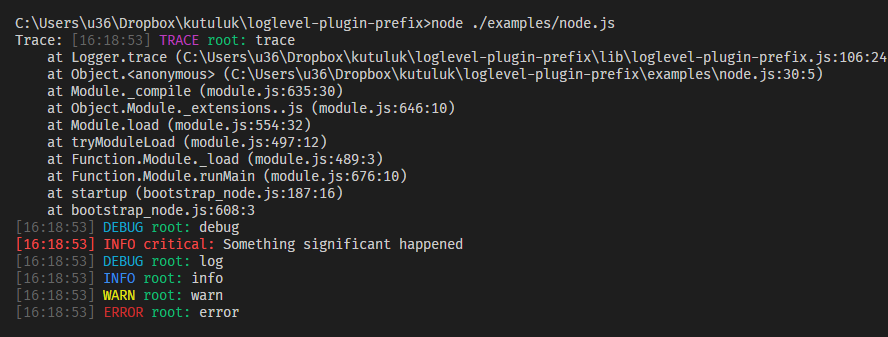
Output
## Custom options
```javascript
const log = require('loglevel');
const prefix = require('loglevel-plugin-prefix');
prefix.reg(log);
log.enableAll();
prefix.apply(log, {
template: '[%t] %l (%n) static text:',
levelFormatter(level) {
return level.toUpperCase();
},
nameFormatter(name) {
return name || 'global';
},
timestampFormatter(date) {
return date.toISOString();
},
});
log.info('%s prefix', 'template');
const fn = (level, name, timestamp) => `[${timestamp}] ${level} (${name}) static text:`;
prefix.apply(log, { format: fn });
log.info('%s prefix', 'functional');
prefix.apply(log, { template: '[%t] %l (%n) static text:' });
log.info('again %s prefix', 'template');
```
Output
```
[2017-05-29T12:53:46.000Z] INFO (global) static text: template prefix
[2017-05-29T12:53:46.000Z] INFO (global) static text: functional prefix
[2017-05-29T12:53:46.000Z] INFO (global) static text: again template prefix
```
## Option inheritance
```javascript
const log = require('loglevel');
const prefix = require('loglevel-plugin-prefix');
prefix.reg(log);
log.enableAll();
log.info('root');
const chicken = log.getLogger('chicken');
chicken.info('chicken');
prefix.apply(chicken, { template: '%l (%n):' });
chicken.info('chicken');
prefix.apply(log);
log.info('root');
const egg = log.getLogger('egg');
egg.info('egg');
const fn = (level, name) => `${level} (${name}):`;
prefix.apply(egg, { format: fn });
egg.info('egg');
prefix.apply(egg, {
levelFormatter(level) {
return level.toLowerCase();
},
});
egg.info('egg');
chicken.info('chicken');
log.info('root');
```
Output
```
root
chicken
INFO (chicken): chicken
[16:53:46] INFO: root
[16:53:46] INFO: egg
INFO (egg): egg
info (egg): egg
INFO (chicken): chicken
[16:53:46] INFO: root
```